
Sweepstakes Casino Legal States in 2026: Bans, Bills and the Updated US Map
Best Non GamStop Casino UK 2026
Loading...
Two years ago, a player in the United States could open a sweepstakes casino from virtually any zip code in the country. The platforms operated in 45 or more states, and the legal challenges they faced were scattered, inconsistent, and easy to ignore. That era is over. In 2026, six states passed explicit legislative bans on sweepstakes casinos, attorneys general in a dozen more issued cease-and-desist orders, and the regulatory environment shifted from passive tolerance to active hostility in a matter of months.
The result, as of early 2026, is a fragmented map. Roughly 33 states still permit sweepstakes casino operations in some form. Six have enacted outright prohibitions with criminal penalties. Several more are considering legislation that could go either way — toward regulation, toward bans, or toward a limbo that satisfies nobody. For players, the practical question is straightforward: can I legally play where I live? The answer, for the first time in the industry’s history, requires checking recent legislation rather than assuming access.
This article covers the current sweepstakes casino state legality landscape bill by bill, enforcement action by enforcement action, and pending proposal by pending proposal. The data is sourced from state legislative records, regulatory filings, and industry analysis — not from operator marketing pages that have every incentive to downplay the crackdown.
The Current Legal Landscape
The simplest way to understand the 2026 map is to divide it into three categories: states where sweepstakes casinos are explicitly banned, states where they operate without specific prohibition, and states where the legal status is ambiguous or actively contested.
In the first category sit the six states that passed bans during 2026: California, New York, Connecticut, Montana, New Jersey, and Nevada. Each enacted legislation with distinct bill numbers — AB 831, SB 5935, SB 1235, SB 555, AB 5447/SB 4282, and SB 256 respectively — and each ban carries its own enforcement provisions, effective dates, and penalties. Washington and Idaho had existing statutes that effectively prohibited the model before the 2026 wave. Michigan’s sweepstakes-specific restrictions and a handful of other pre-existing state-level prohibitions bring the total count of states with some form of ban or restriction to roughly 17.
In the second category — states where sweepstakes casinos continue to operate — the legal basis is not explicit approval. It is the absence of explicit prohibition. No US state has passed legislation affirmatively legalizing the sweepstakes casino model as a distinct category. The platforms operate under the general argument that their dual-currency structure falls outside the statutory definition of gambling, and as long as no state legislature or attorney general has formally disagreed, operators continue to accept players. This is a meaningful distinction: operating in a state is not the same as being licensed or regulated in that state.
The third category is where things get complicated. Several states have active enforcement campaigns without formal bans. West Virginia’s attorney general issued 47 subpoenas to sweepstakes operators. Louisiana sent 40 cease-and-desist letters. Arizona has pursued its own enforcement actions. In these jurisdictions, sweepstakes casinos may still be technically accessible, but the legal risk for both operators and players is elevated.
As Shawn Fluharty, President of the National Council of Legislators from Gaming States and a West Virginia delegate, stated: “This issue has brought lawmakers together … it represents illegal gambling and revenue theft in many states. Rarely do we agree on anything as lawmakers, but on this issue, we agree that this represents illegal gambling operations.”
The speed of the shift cannot be overstated. Between 2012 and 2026, the industry grew from a single operator to over 200 platforms, largely without legislative interference. Then, in a single calendar year, six states enacted bans, regulators across a dozen more launched enforcement campaigns, and the industry’s growth trajectory went from double-digit expansion to projected contraction. Whatever the legal merits of the sweepstakes model, the political environment has turned decisively against it in a significant number of jurisdictions.
Interactive State Map: Where You Can Play
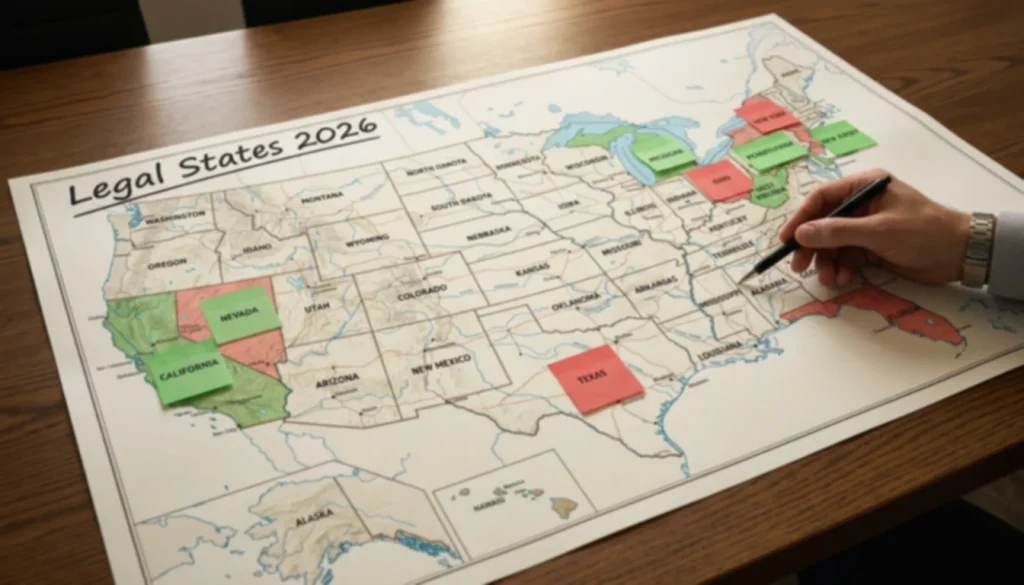
The map below reflects the legal status of sweepstakes casinos across all 50 states and the District of Columbia as of March 2026. States are color-coded into three tiers: green for jurisdictions where sweepstakes casinos currently operate without a specific ban, red for states with enacted legislation prohibiting the model, and yellow for states where enforcement actions are underway or legislation is pending but no ban has yet taken effect.
A few notes on reading the map. Green does not mean “legal.” It means “not yet banned.” The distinction matters because sweepstakes casinos have never been affirmatively legalized anywhere. They operate in a gray zone — permissible only insofar as no one in authority has said otherwise. A green state can turn red with a single legislative session or an aggressive attorney general opinion.
Red states are definitive. California, New York, Connecticut, Montana, New Jersey, and Nevada each passed specific legislation in 2026 targeting the sweepstakes casino model. Washington and Idaho have long-standing prohibitions. Players in these states should assume that accessing a sweepstakes casino platform carries legal risk, even if some operators have been slow to geoblock restricted jurisdictions.
Yellow states require the most attention. West Virginia has not passed a ban, but the attorney general’s office has issued dozens of subpoenas. Louisiana issued 40 cease-and-desist letters to operators. Arizona, Georgia, and several other states have attorneys general who have taken public positions against the sweepstakes model without yet pushing through legislation. In yellow states, the risk is not theoretical — it is administrative. Operators may pull out voluntarily, payment processors may refuse transactions, and individual players may find their accounts frozen or their withdrawals delayed while legal uncertainty persists.
The District of Columbia currently allows sweepstakes casino access. US territories — Puerto Rico, Guam, the US Virgin Islands, American Samoa, and the Northern Mariana Islands — occupy their own regulatory space, and most major operators do not actively market to or accept players from these jurisdictions regardless of legality.
One trend worth flagging: the map is contracting, not expanding. Every legislative change in 2026 moved in one direction — restriction. No state passed a law affirmatively embracing or regulating sweepstakes casinos. Until that pattern reverses, players in currently accessible states should treat their access as provisional rather than permanent.
The Six Bans of 2026: Bill-by-Bill Breakdown
The 2026 legislative wave was not a coordinated federal action. It was six separate state legislatures arriving at the same conclusion independently, each driven by a combination of tribal gaming interests, traditional casino lobbying, revenue concerns, and consumer protection arguments. Here is what each ban actually says.
California — AB 831
California’s ban is the most consequential by market size and the most aggressive by design. Assembly Bill 831 was signed by Governor Gavin Newsom and took effect on January 1, 2026. It classifies online sweepstakes casinos as illegal gambling operations and extends criminal liability beyond the operators themselves to every link in the supply chain: payment processors, geolocation providers, game content suppliers, and media partners that carry advertising. Penalties include fines of up to $25,000 and imprisonment of up to one year.
The supply-chain liability provision is what sets AB 831 apart. Most gambling prohibitions target operators. California’s law targets anyone who facilitates the operation — a structure modeled on human trafficking and money laundering statutes rather than traditional gambling enforcement. For an industry that depends on third-party payment rails, licensed game providers, and digital advertising networks, this approach is designed to make the business model unworkable even if the operators themselves are based offshore.
The financial stakes are enormous. According to Eilers & Krejcik Gaming data, California represented 17.3% of all US sweepstakes casino sales in 2026, worth approximately $2.42 billion out of a $14.31 billion total. Losing that market alone would wipe out nearly a fifth of the industry’s revenue.
As Shawn Fluharty noted at the G2E conference in October 2026, sweepstakes operators “couldn’t get one vote in California. You know how hard that is? They can’t agree on the colour of the carpet.” The unanimous opposition reflected an unusual coalition: tribal gaming interests, licensed card rooms, the California Lottery, and consumer advocacy groups all aligned against the sweepstakes model.
New York — SB 5935
New York’s ban arrived through Senate Bill 5935, targeting online sweepstakes casinos as a category distinct from the state’s broader gambling regulations. New York had already been an enforcement-heavy state before the legislation passed. Attorney General Letitia James sent cease-and-desist orders to 26 sweepstakes operators in 2026, backed by the office’s position that the platforms constituted unauthorized gambling.
The market value at stake in New York is significant. Industry data from iGamingBusiness pegged New York’s sweepstakes casino sales at $762 million in 2026. The state’s motivation is partly protective — New York operates its own licensed mobile sports betting market and has been debating iGaming legalization — and partly fiscal. Every dollar spent on sweepstakes casinos is a dollar that does not flow through a taxed, licensed channel.
Connecticut — SB 1235
Connecticut’s ban is closely tied to its existing compact with the Mashantucket Pequot and Mohegan tribal nations, which operate Foxwoods and Mohegan Sun respectively. The state legalized iGaming in 2021 under exclusive tribal partnerships, and the sweepstakes model represented a direct competitive threat to that arrangement. SB 1235 closed the gap by explicitly classifying sweepstakes casinos as unauthorized gambling operations within the state. Connecticut is one of the smaller markets affected, but the tribal-compact dynamic makes the ban politically durable — it is unlikely to be reversed as long as the compacts remain in force.
Montana — SB 555
Montana’s approach reflects the state’s existing regulatory conservatism around gambling. SB 555 prohibits online sweepstakes casinos, reinforcing Montana’s broader framework that restricts legal gambling to specific, licensed formats including video gambling machines in bars and taverns, sports betting through the state lottery, and tribal casinos. The market size in Montana is relatively small, but the ban signals that opposition to sweepstakes casinos is not limited to large-market states with major gaming industries.
New Jersey — AB 5447 / SB 4282
New Jersey has one of the most mature legal iGaming markets in the country. Atlantic City’s online operations have generated billions in revenue since launching in 2013, and the state’s regulatory framework is among the most comprehensive. AB 5447 and its Senate companion SB 4282 banned sweepstakes casinos to protect that regulated ecosystem. From New Jersey’s perspective, the sweepstakes model is not a regulatory curiosity — it is an unregulated competitor siphoning players and revenue away from licensed operators who pay gaming taxes and submit to state oversight.
Nevada — SB 256
Nevada’s ban is symbolically significant. The state that built its identity on legalized gambling decided that sweepstakes casinos fall outside what it considers legitimate gaming. SB 256 prohibits the model in a state where the Nevada Gaming Control Board exercises some of the most rigorous oversight in the world. The message is unambiguous: if you are not licensed and regulated under Nevada’s framework, you do not get to operate in Nevada. The practical market impact is modest — Nevada’s population is relatively small — but the reputational signal to other states is substantial.
Enforcement Actions: C&Ds, Subpoenas and Lawsuits
Legislative bans represent one front. Enforcement actions represent another — and in some states, the enforcement has been more aggressive than the legislation. According to iGamingBusiness, regulators and attorneys general across more than 12 states issued over 100 cease-and-desist orders to sweepstakes casino operators during 2026. That number is conservative — it counts only documented orders and does not include informal warnings, regulatory inquiries, or pending investigations.
West Virginia has been the most procedurally aggressive state. Attorney General Patrick Morrisey’s office issued 47 subpoenas to sweepstakes operators, demanding financial records, player data, operational details, and compliance documentation. Subpoenas carry more legal weight than cease-and-desist letters because they compel the production of information under penalty of contempt. For operators, responding to 47 simultaneous subpoenas means assembling legal teams, producing documents, and potentially exposing internal business practices to a hostile regulatory audience. Several operators chose to exit the state rather than comply.
Louisiana took a different approach. The state’s attorney general sent approximately 40 cease-and-desist letters to sweepstakes operators, asserting that the platforms violated Louisiana’s gambling statutes. While a C&D letter does not carry the same compulsory force as a subpoena, it establishes an official government position that the activity is illegal. An operator that continues to accept Louisiana players after receiving a C&D does so with the knowledge that the state has formally asserted illegality — which significantly weakens any future defense of good-faith compliance.
Arizona added to the enforcement pressure with its own cease-and-desist campaign, and several other states — including Georgia, Kentucky, and Ohio — have seen regulatory officials make public statements questioning the legality of sweepstakes casinos without yet issuing formal orders.
Beyond regulatory enforcement, the civil litigation landscape has expanded significantly. The American Gaming Association has tracked over 50 active lawsuits against sweepstakes casino operators as of late 2026, ranging from consumer class actions alleging unauthorized gambling to competitor suits brought by licensed operators claiming unfair business practices. The AGA’s broader framing places sweepstakes casinos within a $109 billion unregulated gambling market that it estimates costs the legal industry $17.3 billion annually in lost revenue.
The enforcement trajectory matters as much as the individual actions. In 2023, the total number of documented C&D orders directed at sweepstakes casinos could be counted on two hands. By the end of 2026, it exceeded 100 across a dozen states. That acceleration suggests the issue has moved from an obscure regulatory question to an active priority for state-level law enforcement. For players, the implication is clear: even in states without formal bans, the operational environment for sweepstakes casinos is becoming meaningfully less stable.
Pending Legislation and What to Watch
The 2026 bans were not the end of the legislative cycle. They were the beginning of a pattern that is continuing into 2026, with bills in various stages of committee review, floor debate, and stakeholder negotiation across multiple states. The direction of these bills varies — some would ban sweepstakes casinos outright, while others attempt to bring them into a regulated, taxed framework.
Florida is the most economically significant state to watch. According to industry estimates cited by iGamingBusiness, Florida represents approximately 8.5% of the US sweepstakes casino market, translating to over $1 billion in annual purchases. A proposed 6% tax on sweepstakes revenue could generate an estimated $63 million in state revenue. However, Florida’s regulatory landscape is complicated by the Seminole Tribe’s gaming compact, which grants the tribe exclusive control over most forms of gambling in the state. Any framework that permits sweepstakes casinos would need to navigate that compact, and the tribe has shown no interest in sharing the market.
The direction of pending legislation nationally falls into two broad camps. The first is prohibition, following the 2026 model: classify sweepstakes casinos as illegal gambling and ban them. This is the approach favored by the American Gaming Association, traditional casino operators, and tribal gaming interests. It is politically easier to execute because it does not require creating a new regulatory framework — it simply applies existing gambling prohibitions to a business model that was previously operating in a gap.
The second camp is regulation. The Social Gaming Leadership Alliance (SGLA), the industry’s primary lobbying organization, has argued that sweepstakes casinos should be brought into a licensed, taxed, and regulated framework rather than banned. As Jeff Duncan, former US Congressman and Executive Director of the SGLA, said at the NCLGS Conference in December 2026: “We want to be regulated. We want to pay taxes. It’s never dollar-for-dollar, you’re never wagering your money. In a regulated, taxed environment, there is an opportunity to help the budget of the states that are struggling.”
The regulation argument has economic logic behind it: states that ban sweepstakes casinos forfeit potential tax revenue from an activity that players are demonstrably willing to participate in. States that regulate it can collect taxes, impose consumer protections, and maintain oversight — much as they did with sports betting after the repeal of PASPA in 2018. But the political dynamics are different. Sports betting legalization was driven by consumer demand and fiscal incentives. Sweepstakes casino regulation would face opposition from the same entrenched interests — tribal gaming, traditional casinos, state lotteries — that successfully pushed through the 2026 bans.
Several more states have pre-filed or introduced bills targeting sweepstakes casinos for the 2026 legislative session. The exact list will evolve as sessions progress, but the states most likely to see action include those with active attorney general campaigns, significant tribal gaming presence, or established iGaming markets that view sweepstakes operators as unregulated competition. Players in any state should monitor legislative developments rather than assume the current legal status will hold indefinitely.
What Players Should Do Right Now
The legal landscape for sweepstakes casinos is moving faster than most operators’ terms-of-service pages can keep up with. If you play at one of these platforms, here is what a reasonable, informed approach looks like in 2026.
First, check your state’s current status. Do not rely on the casino’s own state-availability list — some operators have been slow to update geoblocking after bans take effect, and accessing a platform from a banned state may expose you to legal risk even if the site lets you log in. Cross-reference with state attorney general announcements and recent legislative records. If your state passed a ban in 2026, assume it is in force.
Second, do not use a VPN to circumvent geoblocking. This is worth stating explicitly because it is one of the most common pieces of bad advice in online gambling forums. Using a VPN to access a sweepstakes casino from a banned state does not make the activity legal. It makes it harder to detect, which is not the same thing. If you later attempt to redeem Sweeps Coins for cash, the KYC verification process will require your real identity and address — and an address in a banned state will either block your withdrawal or, worse, flag your account for investigation. VPN use also violates the terms of service of every major sweepstakes casino, giving the operator grounds to forfeit your balance entirely.
Third, withdraw regularly. The regulatory environment is volatile. An operator that is accessible today may not be tomorrow — whether due to a new state ban, an enforcement action, or the operator’s own decision to exit a jurisdiction. Maintaining a large unredeemed Sweeps Coin balance is a risk that grows as the legal landscape contracts. If you have SC that meet the playthrough and minimum threshold requirements, convert them to cash rather than letting them sit.
Fourth, keep records. Save transaction histories, purchase receipts, redemption confirmations, and any correspondence with the platform. If a dispute arises — a frozen account, a denied withdrawal, a tax reporting question — having a documented paper trail is the difference between a frustrating inconvenience and a genuine financial loss. Sweepstakes casinos are not regulated the way traditional casinos are, which means the dispute resolution mechanisms available to you are weaker. Your own records are your strongest tool.
Finally, understand that access is not a right. No state has legalized sweepstakes casinos. The platforms operate in a gap, and that gap is closing. Treating your ability to play as something that could change at any time is not pessimism — it is an accurate reading of the current trajectory. Plan accordingly.