
Sweepstakes Casino Slots: RTP Data, Providers and Top Picks
Best Non GamStop Casino UK 2026
Loading...
Return to Player is one of the most important numbers in any casino environment, and one of the least transparent in the sweepstakes space. At regulated online casinos, RTP figures are audited by independent testing labs and published by gaming commissions. At sweepstakes casinos, disclosure is voluntary, verification is rare, and the numbers that do exist come primarily from operator self-reporting rather than regulatory mandate.
The figures available paint an interesting picture. Known RTPs at sweepstakes casinos range from roughly 95% to 99%, competitive with — and in some cases higher than — what regulated casinos offer. But the absence of mandatory auditing means players are taking the operator’s word for it. This guide covers what we know, where the data comes from, and what the departure of major providers in 2026 means for slot quality going forward.
What RTP Means at SC Casinos
RTP stands for Return to Player and represents the percentage of total wagers a game is designed to pay back over time. A slot with 96% RTP returns $96 for every $100 wagered on average across millions of spins. The remaining $4 is the house edge — the operator’s theoretical revenue from that game.
At regulated casinos, RTP is a verified metric. Independent testing agencies like eCOGRA, GLI, and BMM Testlabs audit game software, confirm that the random number generator produces statistically fair outcomes, and certify that the published RTP matches the actual math model. State gaming commissions enforce these standards as a condition of the operator’s license.
Sweepstakes casinos exist outside that framework. No state gaming commission oversees their RTP claims, and no mandatory third-party audit verifies that the numbers published on a game’s info screen match the game’s actual configuration. Some providers — particularly established studios like NetEnt and Hacksaw Gaming — build their games to certified RTP specifications regardless of distribution channel. The game code is the same whether it runs at a regulated casino or a sweepstakes platform. But operators can often configure the RTP within a range set by the provider, choosing between a lower and higher payout setting. Whether a sweepstakes casino runs the same RTP configuration as its regulated counterpart is generally unknowable to the player.
This distinction matters because it affects the practical value of every Sweeps Coin you wager. A slot set to 94% RTP eats your balance twice as fast as one set to 97%. Over a playthrough cycle, the difference compounds — a 1x playthrough on a 97% game preserves most of your SC, while the same playthrough on a 94% game takes a significantly larger bite.
Known RTP Figures
A handful of sweepstakes casinos publish RTP data, and competitive analysis of the market reveals additional data points. The following figures represent what is currently available from operator disclosures and industry research.
Mega Bonanza, a popular jackpot slot available at several SC platforms, reports an RTP of 98.4%. That is exceptionally high — nearly two percentage points above the typical regulated casino slot. Crown Coins Casino has published an overall platform RTP of 97.96%, one of the few operators to disclose an aggregate figure rather than individual game data.
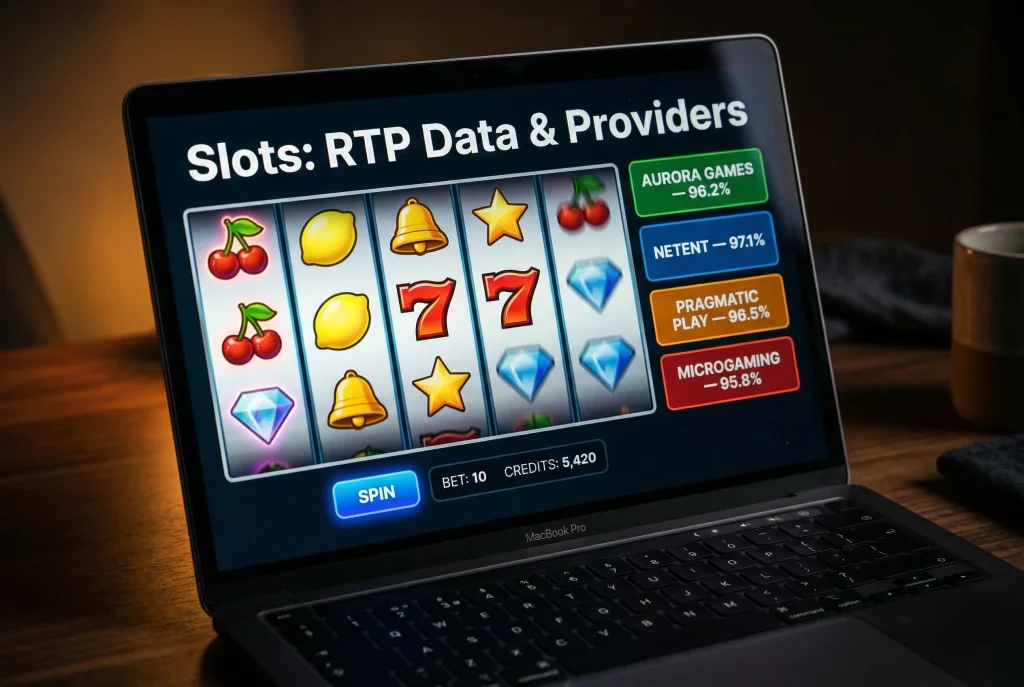
Stake.us slots generally cluster around 96% to 96.5% RTP based on the game library’s provider mix, which draws heavily from established studios. Individual titles vary: a NetEnt game like Starburst runs at 96.09% in its standard configuration, while BGaming titles often publish RTPs in the 96% to 97% range.
Book of 99, a slot by Relax Gaming, carries a headline 99% RTP verified in its math model. It is available at several sweepstakes casinos and represents the upper end of what any commercial slot offers. The trade-off is volatility: high-RTP games often pair generous return rates with extreme variance, meaning individual sessions can diverge sharply from the long-term average.
The comparison with regulated casinos is instructive. US-regulated online casino slots typically run between 92% and 97% RTP, with most landing in the 94% to 96% range. The disclosed sweepstakes figures are competitive at the top end, though the absence of mandatory auditing means the industry average is unknown. Published numbers may reflect cherry-picked data rather than a representative sample of all SC casino slots.
Provider Impact on Slot Quality
The quality of slots at any sweepstakes casino depends heavily on which game providers supply the library. That landscape shifted dramatically in 2026. Pragmatic Play — the single largest game provider in the global online casino market — exited the US sweepstakes market in September 2026, as reported by GamblingInsider. Several other major providers followed or restricted their supply: Evolution (parent of NetEnt and Red Tiger), Playtech, Booming Games, and Live88 all reduced their exposure to the sweepstakes channel.
The departures were driven by regulatory risk. As states moved to ban sweepstakes casinos and enforcement actions escalated, providers with regulated iGaming businesses decided that supplying sweepstakes platforms was not worth jeopardizing their primary licenses. Pragmatic Play’s exit alone removed hundreds of titles from SC casino libraries overnight.
What remains is a smaller but functional provider ecosystem. Hacksaw Gaming continues to supply sweepstakes casinos with a well-regarded catalog of high-volatility slots. BGaming maintains a strong sweepstakes presence. Relax Gaming, Push Gaming, and several niche studios round out the available supply.
The practical impact on players is twofold. First, game libraries are smaller — casinos that once offered 800 or more slots may now list 400 to 600. Second, the remaining providers tend to skew toward higher-volatility designs, meaning bigger potential wins but also faster balance depletion during dry spells. For players who preferred the steady, low-variance slot experience that Pragmatic Play’s catalog excelled at, the current sweepstakes slot landscape offers fewer options.
How Operators Can Adjust RTP
Most game providers offer their titles with configurable RTP settings. A single slot might be available in three configurations: 94%, 96%, and 97%. The operator selects which version to deploy. At regulated casinos, the chosen setting must meet minimum requirements set by the gaming commission, and the selection is auditable. At sweepstakes casinos, neither the floor nor the disclosure requirement exists.
This creates an information asymmetry. A game’s info screen might display the RTP of the provider’s default configuration — typically the highest setting, since it looks best in marketing — while the operator actually runs a lower one. Without third-party auditing, there is no mechanism for players to verify which setting is active.
The sweepstakes casino market grew at a compound annual rate of 60 to 70 percent between 2020 and 2026, according to a KPMG industry primer. Growth of that magnitude attracted operators ranging from established companies with reputational incentives to disclose accurate data, to newer entrants with no track record and no external accountability. The opacity of RTP configuration is not inherently deceptive — but it is a gap that players should be aware of when choosing where to play.
Some casinos have begun voluntarily publishing aggregate payout data. Crown Coins’ disclosure of a 97.96% platform RTP is a step toward transparency. Whether others follow will likely depend on competitive pressure and the evolving regulatory landscape. Until then, prioritize games from established providers with known math models and treat RTP claims from unfamiliar studios or proprietary games with appropriate skepticism.