
Sweepstakes Casino KYC Verification: What You Need and What to Expect
Best Non GamStop Casino UK 2026
Loading...
The first time you request a Sweeps Coin redemption at a sweepstakes casino, you will be asked to verify your identity. This is KYC — Know Your Customer — and it is not a surprise hurdle. It is a standard compliance step driven by anti-fraud requirements and federal tax reporting obligations.
For players accustomed to the instant-gratification pace of online gaming, the KYC process can feel like a roadblock. You have met the playthrough requirements, your SC balance clears the minimum threshold, and now the casino wants a photo of your driver’s license. But understanding what is required, why it is required, and how to get through it quickly can turn a potential frustration into a 10-minute task.
This guide covers the documents you need, the step-by-step process from submission to approval, the most common reasons for rejection, and how your personal data is handled after you submit it.
What Documents Are Required
Most sweepstakes casinos require two categories of documentation for KYC verification: proof of identity and proof of address. Some also require your Social Security number for tax reporting purposes, particularly when cumulative redemptions approach or exceed the $2,000 annual threshold that triggers a 1099-MISC filing under the 2026 rules (raised from $600 under the One Big Beautiful Bill Act).
Proof of Identity — accepted documents typically include a state-issued driver’s license, a US passport, a passport card, or a state identification card. The document must be current (not expired), and the photo must be clearly legible. Military IDs are accepted at some casinos but not all. International passports may work for non-US residents playing from eligible jurisdictions, though the vast majority of SC casino players are US-based.
Proof of Address — this confirms that you reside in a state where the casino operates legally. Accepted documents include a utility bill (electric, gas, water, or internet) dated within the last 60 to 90 days, a bank or credit card statement, or government correspondence such as a tax notice. The address on the proof-of-address document must match the address you provided during registration. If you have recently moved, updating your casino profile before submitting verification documents can prevent a mismatch rejection.
Social Security Number — required for US tax reporting. Most casinos collect this during the KYC process rather than at registration. Your SSN is used to generate the 1099-MISC form when your annual redemptions exceed $2,000 (the 2026 threshold under the OBBBA; previously $600). Players who are uncomfortable providing this information should be aware that refusing will effectively block all redemptions above the threshold, as casinos are legally obligated to report to the IRS.
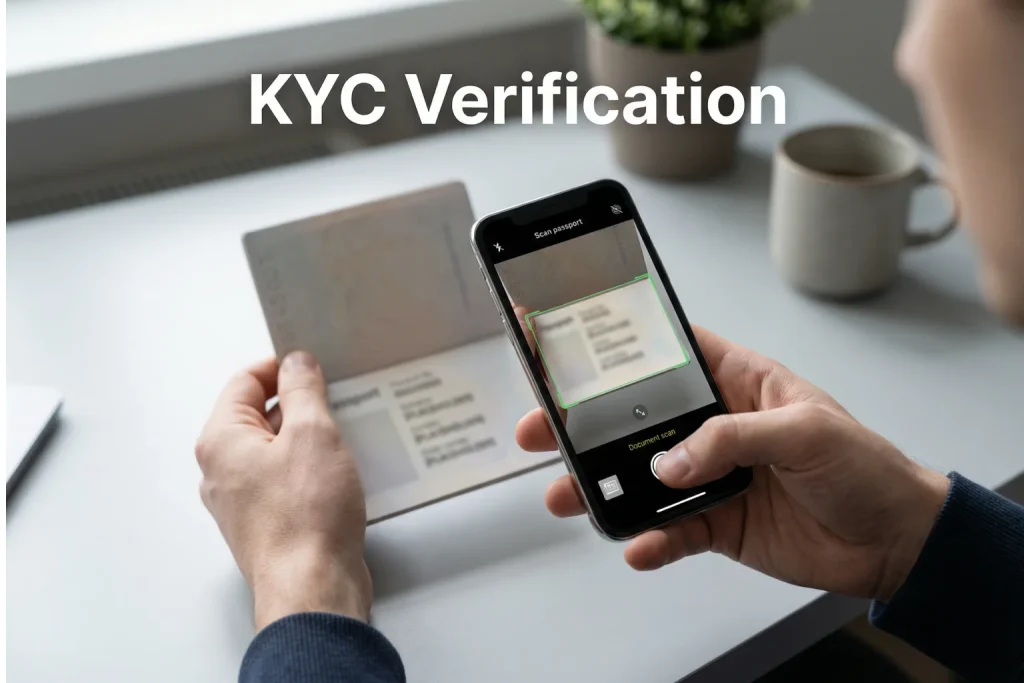
A few casinos have introduced automated KYC using third-party identity verification services. In these systems, you upload a photo of your ID and take a live selfie, which the software matches against the document. Automated verification can reduce processing time from days to minutes, though manual review is still triggered when the automated check cannot confirm a match.
The specific requirements vary by platform. Before starting the process, check your casino’s verification page for the exact list of accepted documents. Submitting the wrong type wastes time for both you and the review team.
Step-by-Step: From Submission to Approval
The typical KYC process at a sweepstakes casino follows a predictable sequence, though the timeline varies by operator.
Step 1: Initiate the request. When you attempt your first SC redemption, the casino will prompt you to complete identity verification. Some platforms allow you to initiate KYC proactively through account settings before your first withdrawal — a smart move that avoids delays when you are ready to cash out.
Step 2: Upload documents. You will be directed to an upload page where you can submit photos or scans of your ID and proof of address. Most casinos accept JPEG, PNG, or PDF formats. File size limits are common, typically 5 MB to 10 MB per file. Use a well-lit environment and a flat surface when photographing documents. Shadows, glare, and cropped edges are the leading causes of rejection.
Step 3: Provide additional information. Depending on the casino, you may be asked to confirm your date of birth, last four digits of your SSN, or answer security questions. Some platforms also request a selfie holding your ID for liveness verification.
Step 4: Wait for review. Processing times range from a few hours at casinos with automated systems to 72 hours or more at platforms relying on manual review. A handful of casinos consistently complete KYC within 24 hours; others routinely take the full 72-hour window. Weekends and holidays can extend timelines further.
Step 5: Receive confirmation. You will get an email or in-app notification confirming approval. Once approved, your redemption request will proceed to the payout queue. Future withdrawals from the same account typically do not require re-verification unless you change your address, name, or payment method.
The entire process usually takes 10 to 15 minutes of active effort on your end. The wait is passive. Players who complete KYC early — before accumulating a redeemable balance — eliminate the delay entirely when it is time to cash out.
Common Rejections and How to Fix Them
KYC rejections happen more often than players expect, and the majority are caused by preventable errors rather than actual compliance issues.
Blurry or partially obscured photos. This is the most frequent rejection reason. If any corner of the ID is cut off, any text is unreadable, or the image has motion blur, the review team will send it back. The fix is straightforward: place the document on a dark, flat surface, ensure even lighting, and photograph it from directly above. Avoid flash if it creates glare on the laminated surface.
Expired documents. An expired driver’s license or passport will not pass verification, even if the photo and information are otherwise accurate. Check the expiration date before uploading. If your ID recently expired and you are waiting for a renewal, some casinos accept a temporary paper ID alongside a secondary form of identification.
Address mismatch. The address on your proof-of-address document must match what is on file in your casino account. If you registered with an old address and your utility bill shows a new one, you will get rejected. Update your profile first, then resubmit. Some casinos require you to contact support to change your registered address, which adds a step but is usually resolved within a business day.
Name discrepancies. If your ID shows your legal name but you registered with a nickname or abbreviated version, the system may flag a mismatch. Similarly, recent name changes due to marriage or legal proceedings can cause issues if the ID has not been updated. A supporting document — such as a marriage certificate or court order — can usually resolve this.
Low-quality scans of proof of address. Utility bill screenshots from a mobile app sometimes get rejected because the resolution is too low or because key details (name, address, date, provider) are not all visible on a single screen. Download the PDF version of your statement if available, or take a clear photo of the physical document.
Most casinos allow unlimited resubmission attempts. If you are rejected, the notification typically explains why, and you can upload corrected documents immediately. Persistent rejections with no clear explanation may require contacting customer support directly — a process that varies in quality from platform to platform.
Privacy and Data Handling
Submitting government-issued identification and your Social Security number to an online platform is a reasonable source of concern. The question is not whether to be cautious — you should be — but whether the specific casino you are dealing with handles that data responsibly.
Most established sweepstakes casinos use encrypted connections (SSL/TLS) for document uploads and store sensitive information in compliance with data protection standards. Larger operators employ third-party identity verification services — companies like Jumio, Onfido, or Socure — which specialize in secure document processing and are subject to their own regulatory compliance requirements. In these cases, the casino itself may never directly handle your raw document images; the verification service processes them and returns a pass/fail result.
That said, the sweepstakes casino industry does not operate under the same regulatory oversight as licensed gambling operators, where state gaming commissions enforce strict data handling rules. The $415 million class action settlement against DoubleDown Interactive — while primarily about gambling law violations rather than data breaches — illustrated the scale of legal exposure that can arise when player-facing practices do not meet legal standards. For KYC purposes, the reminder is relevant: the operator you trust with your SSN and ID should have a verifiable track record and a clear privacy policy.
Before submitting documents, check whether the casino’s privacy policy specifies how long KYC data is retained, who has access to it, and under what circumstances it is shared with third parties. Legitimate operators will have this information readily available. If the policy is vague, missing, or buried behind multiple clicks — treat that as a signal about the platform’s overall approach to compliance.
One practical safeguard: if possible, use the casino’s in-app upload tool rather than sending documents via email. Email transmissions are not encrypted end-to-end by default and create additional copies of sensitive files in transit. The dedicated upload system, while not foolproof, offers a more controlled path for your data.