
Social Casino vs Sweepstakes Casino: Understanding the Key Difference
 Available in US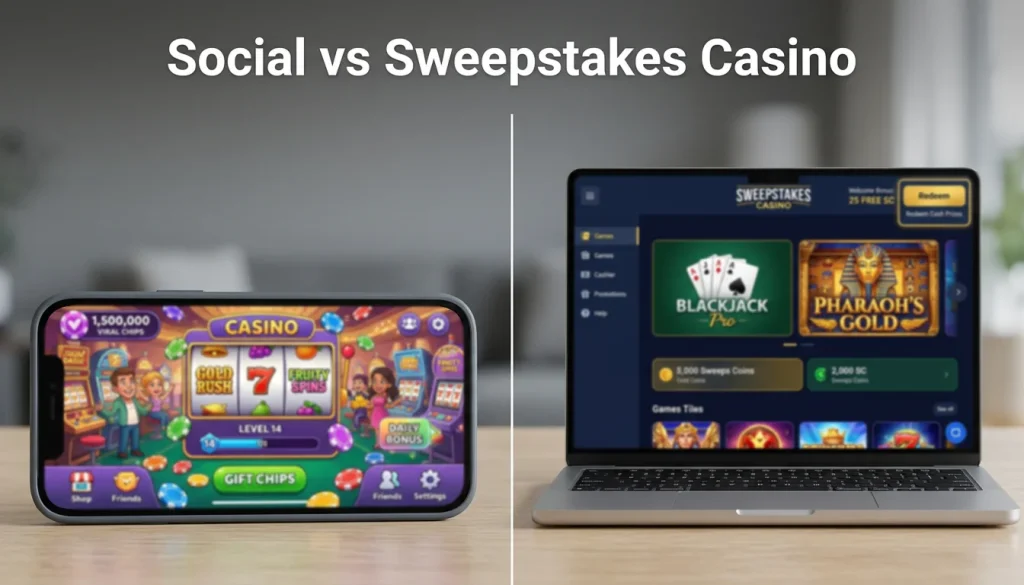
The terms “social casino” and “sweepstakes casino” are frequently used interchangeably — by players, media, and sometimes even by the platforms themselves. But the two models are structurally different in one critical way: social casinos offer no path to cash prizes. You buy virtual chips, you play games, you win more virtual chips, and that is where the cycle ends. Sweepstakes casinos, by contrast, operate a dual-currency system where Sweeps Coins can be redeemed for real money.
This distinction — cash prizes or no cash prizes — creates fundamentally different legal classifications, player motivations, monetization models, and regulatory exposures. The confusion between the two models is not harmless. It has contributed to regulatory backlash against both categories and produced one of the largest legal settlements in online gaming history. Understanding what separates social casinos from sweepstakes casinos is essential for any player or observer trying to make sense of this space.
Social Casino Model Explained
Social casinos are entertainment platforms that simulate casino games using virtual currencies that have no cash value and cannot be converted to real money. The model originated on Facebook in the late 2000s and early 2010s, with games like DoubleDown Casino, Slotomania, and House of Fun attracting tens of millions of players who wanted the experience of slot machines and table games without the financial risk — or reward — of real gambling.
Monetization in the social casino model relies on in-app purchases. Players buy virtual chips or coins to extend their play sessions, access premium games, or replenish a balance that has been depleted through gameplay. The chips have no redemption value — you cannot convert them to cash, transfer them to another player for consideration, or use them anywhere outside the platform. The purchase is, by design, a one-way transaction: money flows in, entertainment flows out.
The scale of this model is substantial. According to data cited by the SPGA and Eilers & Krejcik Gaming, US consumers spent over $40 billion on social casino products over the past decade. That figure encompasses both pure social casinos (no cash prizes) and the broader category of social gaming that overlaps with sweepstakes models. The market’s size reflects the genuine demand for casino-style entertainment among audiences who are unable or unwilling to gamble with real money — whether due to legal restrictions, personal preference, or risk aversion.
The classic social casino brands — DoubleDown, Slotomania, Heart of Vegas, and their peers — are typically available through mobile app stores and Facebook. They operate legally in all US states because they do not involve gambling under any mainstream legal definition: there is no prize of monetary value, so the consideration-chance-prize framework that defines gambling is not satisfied. This universal legality was, for years, the social casino model’s primary competitive advantage over both traditional casinos (restricted to specific states) and the nascent sweepstakes model.
Sweepstakes Casino Model Explained
Sweepstakes casinos build on the social casino foundation but add a critical layer: a second currency — Sweeps Coins — that can be redeemed for cash. The dual-currency structure is the defining innovation. Players buy Gold Coins (equivalent to social casino chips — no cash value), receive bonus Sweeps Coins as part of the purchase, play games with either currency, and redeem SC for real money after meeting playthrough requirements.
The legal justification for this model rests on the sweepstakes framework. Because Sweeps Coins can be obtained for free (through daily logins, AMoE mail-in requests, social media giveaways, and other methods), the operator argues that no purchase is necessary to participate in the sweepstakes — thereby removing the “consideration” element that would make the activity gambling under most legal definitions. Players who buy Gold Coins are purchasing a virtual entertainment product; the SC they receive as a bonus is a promotional prize, not a gambling wager.
In 2026, sweepstakes casinos generated approximately $10 billion in purchases, according to Eilers & Krejcik Gaming research. The growth trajectory of the sweepstakes model has dramatically outpaced pure social casinos over the past five years, driven by a straightforward consumer preference: given the choice between casino games with no cash prize and casino games with the possibility of cashing out, most players prefer the latter.
Head-to-Head Comparison
The structural differences between social and sweepstakes casinos manifest across every dimension of the player experience and the operator’s business model.
Cash prizes. Social casinos: none. All winnings are virtual and cannot be converted to cash. Sweepstakes casinos: yes, through SC redemption after playthrough. This is the defining difference and the one that matters most to players.
Legal classification. Social casinos are generally classified as entertainment products, not gambling. They are legal in all 50 states and available through mainstream app stores without restriction. Sweepstakes casinos occupy a contested legal space — classified by operators as promotional sweepstakes, classified by an increasing number of states and regulators as gambling. Six states banned sweepstakes casinos in 2026; no state has banned social casinos through legislation.
Regulation. Social casinos face minimal gaming-specific regulation. Consumer protection law, app store policies, and general fraud statutes apply, but no gaming commission oversees their operations. Sweepstakes casinos face a patchwork: no federal regulation, voluntary self-regulation through the SPGA, and increasing state-level enforcement. The regulatory pressure on sweepstakes casinos is intensifying; social casinos face comparatively little.
Taxation. Social casino purchases are consumer spending with no tax implications beyond standard sales tax (where applicable). Sweepstakes casino SC redemptions above $600 trigger IRS Form 1099-MISC reporting, and withholding at 24% applies to prizes above $5,000. This tax treatment — applied to sweepstakes but not social casinos — reflects the government’s view that SC redemptions constitute prize income.
Player motivation. Social casino players are primarily motivated by entertainment — the experience of playing casino-style games in a no-risk environment. Sweepstakes casino players demonstrate mixed motivations: some play purely for entertainment, but survey data indicates that 68% play at least partly with the intention of winning money. This motivational difference shapes player behavior, spending patterns, and expectations.
Monetization model. Both models rely on in-app purchases of virtual currency. But the conversion economics differ. Social casinos retain 100% of purchases as revenue (no prizes to pay out). Sweepstakes casinos return 65–70% of purchases to players as SC prizes, retaining 30–35% as net revenue. The sweepstakes model generates higher gross spending per user (players spend more when there is a possibility of getting money back) but lower net revenue per dollar spent.
Legal Implications and the DoubleDown Case
The most consequential legal action in the social casino space has blurred the very distinction this article describes. The $415 million class action settlement involving DoubleDown Interactive — a pure social casino, not a sweepstakes platform — established that even games with no cash redemption mechanism can be classified as gambling under certain state laws.
The lawsuit, documented in SEC EDGAR filings, argued that DoubleDown’s virtual chips constituted something of value under Washington state’s gambling statute, and that the platform’s mechanics — designed to encourage repeated purchases through loss cycles and psychological engagement patterns — met the legal definition of gambling. The $415 million settlement did not require DoubleDown to admit wrongdoing, but its size signaled the seriousness of the legal risk and set a precedent that other social casino operators are now navigating.
The DoubleDown case has implications for both social and sweepstakes casinos. For social casinos, it demonstrates that the absence of cash prizes does not guarantee legal safety — the definition of “something of value” is broader than cash in some jurisdictions, and virtual chips that players purchase and can lose may qualify. For sweepstakes casinos, the case reinforces the argument that if even non-redeemable virtual currency can be classified as gambling, then redeemable Sweeps Coins are even more clearly within gambling territory.
The regulatory response to the DoubleDown settlement has been muted so far — no state has passed legislation specifically targeting pure social casinos in response to the case. But the precedent exists, and consumer class action attorneys are aware of it. Future litigation against either social or sweepstakes platforms will reference DoubleDown as evidence that virtual-currency gaming models are vulnerable to gambling classification regardless of whether they offer cash redemption.
For players, the practical takeaway is straightforward: social casinos offer no path to cash prizes but currently face less regulatory risk. Sweepstakes casinos offer real prize potential but operate in an increasingly contested legal environment. The choice between them depends on whether the possibility of cashing out — and the regulatory uncertainty that accompanies it — is worth the trade-off of a potentially less stable platform experience.
Social Casino vs Sweepstakes Casino — More on this topic at sc casino online.
See also Sweepstakes Casino Glossary.