
Responsible Gaming at Sweepstakes Casinos: Tools, Limits and Industry Standards
 Available in US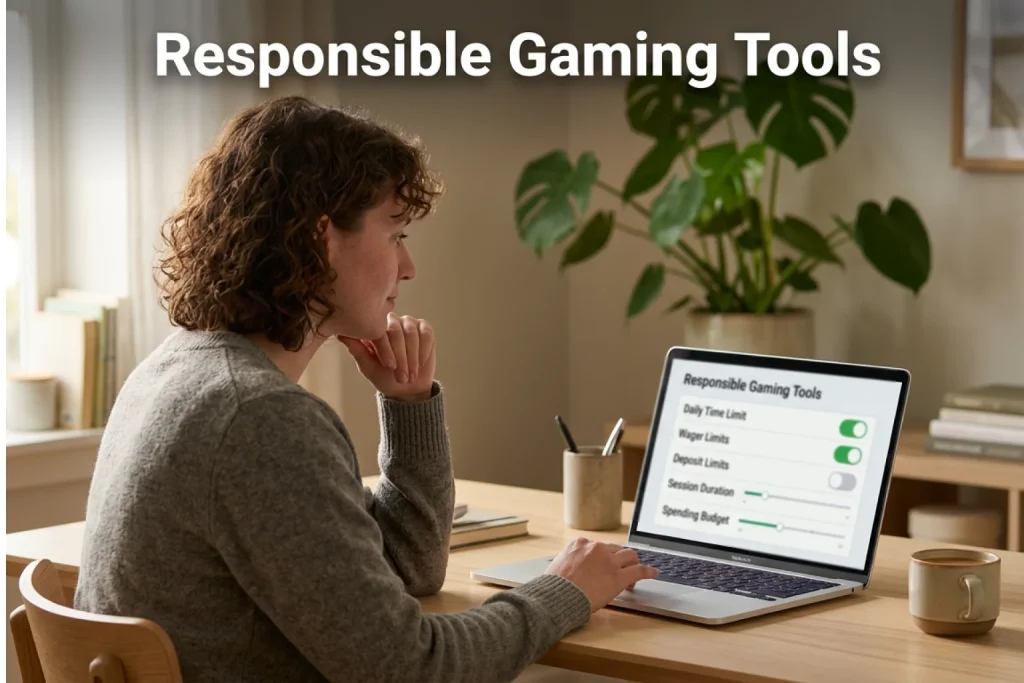
Sweepstakes casinos are not legally obligated to meet the same responsible gaming standards as state-licensed casinos. There is no federal mandate requiring SC platforms to offer self-exclusion programs, deposit limits, or helpline access. This gap exists because the sweepstakes model classifies itself as promotional rather than gambling — a distinction that exempts it from the regulatory frameworks that impose responsible gaming requirements on licensed operators.
The practical reality is more nuanced. Some sweepstakes casino operators voluntarily implement responsible gaming tools, driven by a combination of consumer expectations, industry self-regulation through the SPGA Code of Conduct, and the practical awareness that problem gambling allegations could accelerate regulatory action against the model. Others do the bare minimum or nothing at all. Understanding which tools exist, where the gaps are, and what resources are available independently of the casinos themselves is essential for any player engaging with the sweepstakes model.
SPGA Code of Conduct: What It Covers
The Social and Promotional Gaming Association introduced its Code of Conduct in December 2026, establishing a voluntary framework for sweepstakes casino operators who choose to participate. The Code addresses four primary areas: age verification, responsible play messaging, self-exclusion availability, and data protection. It represents the industry’s most structured attempt at self-regulation to date.
On age verification, the Code requires member operators to implement identity checks that prevent underage access to sweepstakes platforms. This includes age gates at registration, identity verification during the KYC process, and monitoring systems designed to detect and block accounts created by minors. In practice, the rigor of these systems varies by operator — some deploy sophisticated ID verification technology, while others rely on self-reported birthdate entries that are trivially circumventable.
Responsible play messaging under the Code includes displaying warnings about the risks of excessive play, providing information about problem gambling resources, and avoiding marketing that targets vulnerable populations. The advertising dimension is particularly relevant given the scale of sweepstakes casino marketing. According to data from the AGA and Sensor Tower, approximately 50% of all online casino advertising exposure in the United States comes from sweepstakes casinos rather than licensed operators. That volume of advertising creates correspondingly large responsibility for the messaging it carries — a responsibility that the SPGA Code attempts to address, though enforcement remains voluntary.
Self-exclusion provisions in the Code ask members to provide mechanisms for players to voluntarily restrict their own access to the platform — either temporarily or permanently. The Code also calls for operators to honor self-exclusion requests across related brands (if a single company operates multiple sweepstakes casinos). Data protection requirements align with standard practices around encryption, secure storage, and controlled access to player personal information.
The fundamental limitation of the SPGA Code is that it is voluntary and self-enforced. There is no independent audit process, no penalty for non-compliance, and no public reporting requirement. Operators that violate the Code face reputational consequences among industry peers but no regulatory sanction. For comparison, licensed casinos in regulated states face fines, license suspension, or revocation for responsible gaming failures — enforcement mechanisms that the SPGA Code lacks entirely.
Available Tools at Major SC Casinos
The range of responsible gaming tools offered by sweepstakes casinos varies significantly. Some platforms provide a suite of controls comparable to what regulated casinos offer. Others provide almost nothing beyond a generic link to a problem gambling helpline buried in their footer.
Deposit (purchase) limits. Several major SC casinos allow players to set daily, weekly, or monthly caps on Gold Coin purchases. Once the limit is reached, additional purchases are blocked until the next period. This is one of the more impactful tools because it directly constrains spending. Platforms that offer this feature include Chumba Casino, WOW Vegas, and Pulsz, though the specific limit options and the ease of adjusting them (upward versus downward) differ. A critical design detail: reducing a limit should take effect immediately, while increasing it should require a cooling-off period. Not all casinos implement this asymmetry.
Session timers. Some platforms display pop-up notifications after a set period of continuous play — typically 60 or 90 minutes — reminding the player how long they have been active. These reality-check interruptions are a standard tool in regulated gaming and have shown modest effectiveness in research settings. Among sweepstakes casinos, implementation is inconsistent: some offer configurable session limits that lock the player out after the set time, while others simply display a dismissible notification that players can ignore without consequence.
Self-exclusion. The most consequential responsible gaming tool is self-exclusion — the ability for a player to voluntarily block their own access to a platform for a defined period or permanently. Major operators generally offer some form of self-exclusion, but the implementation details matter. Key questions include: Can the player reverse the exclusion before the period ends? Does exclusion carry across the operator’s other brands? Is the excluded player’s data retained or deleted? Is there a formal process for reinstatement that includes a waiting period and re-evaluation? The answers vary by casino, and players in need of self-exclusion should verify the specific terms before relying on this feature.
Helpline access. Displaying problem gambling helpline numbers — such as the National Problem Gambling Helpline at 1-800-522-4700 — is the most basic responsible gaming measure. It requires no technical implementation, only a visible link or phone number. Yet the visibility of this information at sweepstakes casinos is often poor. Independent reviews have found that helpline information, when present, is frequently placed only in the Terms of Service or the footer — areas that most players never view during normal use.
The Gap: What Is Missing
The gap between responsible gaming standards at regulated casinos and those at sweepstakes casinos is both measurable and significant. Licensed casinos in states like New Jersey, Pennsylvania, and Michigan operate under detailed responsible gaming requirements enforced by gaming commissions with investigative and penalty authority. Sweepstakes casinos operate under no comparable external mandate.
The demographic data underscores why this gap matters. According to AGA survey research, approximately 80% of sweepstakes casino players report spending money monthly, and 42% of players have household incomes below $50,000 per year. These are not characteristics of a casual, risk-free entertainment audience — they describe a population for whom financial losses from gambling-like activity have tangible impact on daily life.
Several specific gaps stand out. First, there is no universal self-exclusion database for sweepstakes casinos. In regulated gaming, many states maintain centralized self-exclusion registries that apply across all licensed operators. A player who self-excludes from one licensed casino is automatically excluded from all others in that state. No equivalent system exists for sweepstakes casinos — a player who self-excludes from Chumba can immediately sign up at WOW Vegas, Pulsz, or any other platform.
Second, spending data is not shared or aggregated. Regulated markets can track individual player spending across platforms to identify problem patterns. Sweepstakes casinos operate as isolated silos — no operator knows how much a player spends at competing platforms, and no external body aggregates this information. A player who sets a $200 monthly purchase limit at one casino can maintain identical limits at ten others, spending $2,000 monthly total with no systemic check.
Third, marketing practices lack external oversight. The AGA has invested over $500 million in responsible gaming programs within the regulated sector, including advertising guidelines enforced by state regulators. Sweepstakes casino advertising — accounting for half of all online casino ad exposure — follows no mandatory guidelines beyond the SPGA’s voluntary Code. The contrast between the regulatory burden on licensed operators’ marketing and the freedom enjoyed by sweepstakes casino marketing creates a persistent tension that regulators and legislators have increasingly cited in justifying bans.
Fourth, complaint resolution mechanisms are weak. Players at regulated casinos can file complaints with their state gaming commission, which has authority to investigate and impose penalties. Sweepstakes casino players have no equivalent recourse beyond the casino’s own customer support, social media pressure, or civil litigation — all of which are slower, less effective, and less accessible than a regulatory complaint process.
Resources and Support
Regardless of the tools a specific sweepstakes casino provides, external resources are available to anyone who is concerned about their gambling behavior or that of someone they know. These resources operate independently of any casino and are not restricted by the responsible gaming policies — or lack thereof — of individual platforms.
The National Problem Gambling Helpline (1-800-522-4700) is available 24 hours a day, 7 days a week. It is operated by the National Council on Problem Gambling and provides confidential support, information, and referrals. The helpline also offers a text-based option: text “GAMBLER” to 1-800-522-4700.
Gamblers Anonymous (gamblersanonymous.org) maintains a directory of meetings — both in-person and virtual — organized by state. The program follows a peer-support model similar to other twelve-step programs and is free to attend.
State-level programs offer additional resources tailored to local availability. Many states fund their own problem gambling councils with dedicated helplines, treatment referral networks, and educational materials. Your state’s resources can typically be found through the National Council on Problem Gambling’s state affiliate directory.
For players who recognize that they are spending more than they can afford, the most immediate action is to use whatever self-exclusion and purchase limit tools are available at the platforms you use — imperfect as they may be. Combine platform-level controls with personal financial safeguards: removing saved payment methods, setting spending alerts through your bank, and establishing a dedicated budget for entertainment spending that is separate from essential expenses. These measures do not replace professional support when needed, but they create friction that can slow impulsive behavior while you assess next steps.
Responsible Gaming at Sweepstakes Casinos — More on this topic at sc casino online.
See also Sweepstakes Casino Payment Methods.