
Sweepstakes Casino Banned States in 2026: Complete List with Bill Numbers
 Available in US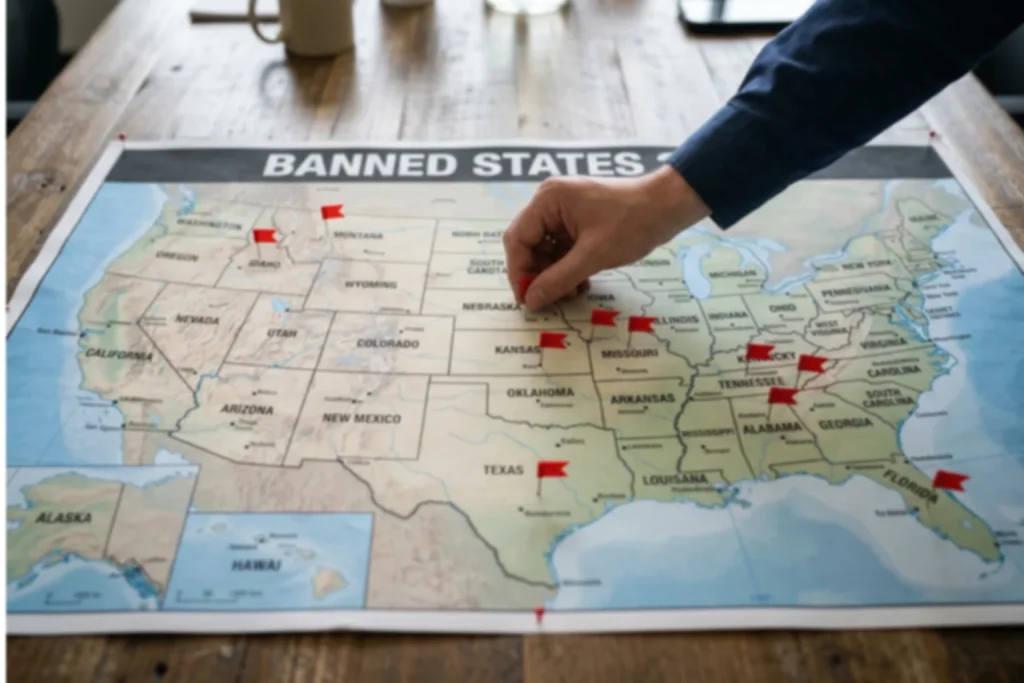
The legal landscape for sweepstakes casinos in the United States contracted sharply in 2026. Six states enacted legislative bans within a single calendar year — more than the total number of states that had restricted sweepstakes casinos in all prior years combined. According to reporting by GamblingInsider, these bans collectively removed access to some of the largest sweepstakes markets in the country and triggered a downward revision in industry growth forecasts for the first time.
Beyond legislative bans, additional states have achieved de facto prohibition through aggressive enforcement — cease-and-desist letters, attorney general subpoenas, and coordinated legal pressure that makes operators withdraw voluntarily. The distinction between a legislative ban and an enforcement-driven ban matters legally, but for players the practical outcome is the same: no access. This guide documents every state where sweepstakes casinos are currently prohibited, the specific laws or enforcement actions behind each restriction, and which states may be next.
States with Legislative Bans
Six states passed sweepstakes casino bans into law during 2026, each through distinct legislative vehicles. The specifics matter because the scope, penalties, and enforcement mechanisms differ significantly across jurisdictions.
California — AB 831 (effective January 1, 2026). The most comprehensive ban in the country. AB 831 criminalizes not only the operation of sweepstakes casinos but the entire supply chain: payment processors, geolocation providers, game studios, and media partners promoting SC platforms to California residents. Penalties include fines up to $25,000 and imprisonment for up to one year per violation. According to analysis by Frankfurt Kurnit Klein & Selz, the supply chain liability provision is unprecedented in US gaming law. California represented approximately 17.3% of total sweepstakes revenue — the largest single-state market at $2.42 billion — making this ban the most financially consequential of the six.
New York — SB 5935. New York’s ban targeted sweepstakes casinos following extensive enforcement activity by the state attorney general’s office, which had already issued 26 cease-and-desist letters to operators before the legislation passed. The state’s sweepstakes market was valued at approximately $762 million, making it the second-largest revenue loss among the 2026 bans. The law broadly prohibits the operation and promotion of online sweepstakes casinos within the state.
Connecticut — SB 1235. Connecticut’s ban reflects the state’s existing investment in regulated iGaming and sports betting. With licensed online casinos already operating through tribal partnerships (Mohegan Sun and Foxwoods), lawmakers viewed unregulated sweepstakes casinos as direct competitors to a legally established, taxed market. SB 1235 prohibits sweepstakes casino operations within the state.
Montana — SB 555. Montana’s approach was driven by existing gambling restrictions and the state’s relatively conservative regulatory posture toward online gaming. SB 555 classifies sweepstakes casino participation as illegal gambling under state law, aligning the sweepstakes model with the same prohibitions applied to unlicensed real-money gambling.
New Jersey — AB 5447 / SB 4282. Like Connecticut, New Jersey’s ban was motivated by the presence of a thriving regulated iGaming market. The state generates hundreds of millions annually from licensed online casinos and viewed sweepstakes operators as unlicensed competitors siphoning revenue from the taxed market. The dual bill numbers reflect parallel tracks in the Assembly and Senate that converged into a single legislative prohibition.
Nevada — SB 256. Nevada’s ban carries symbolic weight beyond its market impact. As the historic center of US gambling and the state with the most established gaming regulatory framework, Nevada’s decision to ban sweepstakes casinos sent a clear signal about how the traditional gaming industry views the SC model. SB 256 prohibits sweepstakes casino operations, reinforcing Nevada’s position that online gambling should occur only through licensed, regulated channels.
States with De Facto Bans via Enforcement
Several states have achieved effective prohibition without passing sweepstakes-specific legislation. Instead, they have used existing gambling laws, attorney general authority, and aggressive enforcement actions to force operators out of the market. According to iGamingBusiness reporting, more than 100 cease-and-desist letters were issued across 12 or more states during 2026, supplemented by subpoenas, formal investigations, and civil lawsuits.
Washington. Washington state has long treated sweepstakes casinos as illegal gambling under its broadly worded gambling statutes. The state gambling commission has consistently maintained that the sweepstakes model does not qualify for any exemption, and operators have geo-blocked Washington proactively rather than risk enforcement action. This makes Washington a pre-2026 de facto ban state that was never contested seriously by the industry.
Idaho. Similar to Washington, Idaho’s restrictive gambling laws have historically been interpreted to cover sweepstakes casino activity. Operators have generally excluded Idaho from their service areas rather than challenge the state’s position, resulting in a de facto ban that predates the 2026 legislative wave.
West Virginia. West Virginia’s attorney general launched one of the most aggressive enforcement campaigns against sweepstakes casinos in 2026, issuing 47 subpoenas to operators and related companies. Delegate Shawn Fluharty, who also serves as president of the National Council of Legislators from Gaming States (NCLGS) and head of government affairs at Play’n GO, has been a vocal advocate for treating sweepstakes casinos as illegal gambling operations. The scale of enforcement activity in West Virginia — 47 subpoenas from a single state — represents one of the largest coordinated actions against the sweepstakes industry.
Louisiana. Louisiana’s attorney general issued approximately 40 cease-and-desist letters to sweepstakes casino operators in 2026. While the state has not yet passed a formal legislative ban, the volume of enforcement action has produced a chilling effect: major operators have withdrawn or restricted access to Louisiana residents rather than face potential prosecution under existing gambling laws.
Arizona. Arizona joined the enforcement wave with additional cease-and-desist actions against sweepstakes platforms. The state’s gaming compact with tribal nations creates political incentives similar to those in Florida and Connecticut — any unregulated gaming activity is viewed as competitive with tribal operations that generate tax revenue and are subject to oversight.
States Under Watch
Beyond the states with existing bans or active enforcement, several jurisdictions have introduced legislation or signaled regulatory intent that could result in additional restrictions during 2026 and beyond.
Florida remains the most significant undecided market. With over $1 billion in annual sweepstakes revenue and active legislative proposals for both prize caps and a 6% tax, Florida’s decision could tip the industry’s financial trajectory one way or the other. The Seminole Tribe’s lobbying against unregulated sweepstakes adds political momentum toward some form of restriction.
Texas represents another high-value market under increasing scrutiny. As one of the largest states by population without regulated iGaming, Texas has a substantial sweepstakes player base. Legislative committees have begun examining the model, though no formal bill has advanced to a floor vote.
Ohio, Michigan, and Pennsylvania — all states with established regulated iGaming markets — are monitoring the sweepstakes landscape. The same competitive dynamic that drove bans in New Jersey and Connecticut exists in these states: licensed operators paying gaming taxes view untaxed sweepstakes casinos as unfair competitors. Whether this translates into legislative action depends on political priorities and industry lobbying during upcoming sessions.
The common thread across all states under watch is the presence of either an existing regulated gaming market that sweepstakes casinos compete with, or a political environment that views the SC model as insufficiently regulated. States with neither characteristic — those without iGaming and without strong anti-gambling sentiment — are least likely to pursue bans in the near term.
How Bans Are Enforced in Practice
A legislative ban or enforcement action is only as effective as its implementation. In practice, sweepstakes casino bans are enforced through several overlapping mechanisms that collectively make it difficult — though not impossible — for restricted-state residents to access SC platforms.
Geolocation blocking is the primary enforcement tool at the operator level. Sweepstakes casinos use IP-based and GPS-based geolocation services to determine a player’s physical location. When a state ban takes effect, compliant operators configure their systems to deny access from that state’s IP ranges and GPS coordinates. This is the same technology that licensed sportsbooks and iGaming platforms use to enforce state-by-state access restrictions.
Payment processor restrictions add a second layer. Following California’s AB 831 — which explicitly holds payment companies criminally liable — processors have become more cautious about handling sweepstakes transactions from banned states. Banks and payment companies generally prefer to over-comply rather than risk legal exposure, which means that even if a player circumvents geolocation checks, completing a purchase or withdrawal may be blocked at the financial layer.
VPN use is the obvious workaround that players in banned states may consider, and operators are aware of it. Most sweepstakes casino terms of service explicitly prohibit VPN usage to misrepresent location, and platforms increasingly deploy VPN detection alongside standard geolocation. Players caught using VPNs risk account closure and forfeiture of balances — both Gold Coins and Sweeps Coins. More importantly, playing from a banned state may expose the player to legal risk under that state’s gambling laws, regardless of how they access the platform.
The practical enforcement rate is imperfect. No geolocation system is flawless, and determined users can sometimes access platforms from restricted states. But the combination of geo-blocking, payment restrictions, and VPN detection creates enough friction that casual access from banned states is effectively prevented — which is the operational goal of most enforcement efforts.
Sweepstakes Casino Banned States in 2026 — More on this topic at sc casino online.
See also How to Redeem Sweeps Coins for Cash.